Lab Grown Diamond Price India 2026: Live Calculator + Rate Chart


By Chaitra Fine Jewels · Updated August 7, 2026 · Bengaluru, India · Live · Updated Monthly
If you’re checking the diamond rate today, the contrast is brutal. A high-quality 1-carat natural diamond in India costs around ₹1,80,000. The lab grown diamond price in India for an identical 1-carat stone is ₹40,000 to ₹55,000. Same hardness. Same sparkle. Same IGI certification. Just 70% less.
But ₹40,000 to ₹55,000 is still a wide range. Whether you pay ₹40K or ₹55K depends on cut, colour, clarity, and shape. This guide has the current rate chart, a live calculator below to estimate your specific specs, and a free way to get a custom quote on WhatsApp in 24 hours.
Lab Grown Diamond Price Estimator — India Market Rates
See what most Indian jewellers quote for your specs. Then get Chaitra's actual price.
Chaitra's price will surprise you. Most buyers tell us they expected higher.
Get Chaitra's Quote — Usually Lower →Reply in 24 hours · No commitment · No haggling
Lab Grown Diamond Price Chart — India, August 2026
The lab grown diamond price in India ranges from ₹15,000 to ₹4,00,000+ per loose stone depending on carat weight and quality. Below is the current rate chart for IGI-certified lab-grown diamonds in excellent (E-F / VVS) quality, the best-value spec for most buyers.
| 0.5 Carat (E/VVS) | ₹13,000 – ₹18,000 |
| 1 Carat (E/VVS) | ₹40,000 – ₹55,000 |
| 2 Carat (E/VVS) | ₹80,000 – ₹1,20,000 |
| 3 Carat (E/VVS) | ₹1,45,000 – ₹2,00,000 |
| vs Natural Diamond | 60–75% less |
| Certification | IGI certified (same standard) |
Source: Chaitra Fine Jewels pricing data, August 2026. Prices for loose diamonds, round brilliant cut. Ring settings add ₹15,000 – ₹40,000 depending on gold weight.
Get your Curated Edit (free)
Eight real lab grown diamond pieces at every budget — from ₹21K to ₹2.5L+. Sent to your inbox with WhatsApp links per piece. No spam. Unsubscribe anytime.
Send Me the Edit →Real prices · WhatsApp ready · Refreshed monthly
In This Guide
- Why Lab Grown Diamond Prices Are Where They Are
- Lab Grown Diamond Price in India by Carat Weight
- What Affects Lab Grown Diamond Price
- Lab Grown Diamond Price by Shape
- Lab Grown vs Natural Diamond Price Comparison
- Lab Grown Diamond Jewellery Prices in India
- Where to Buy Lab Grown Diamonds in India
- Lifetime Buyback: What Your Diamond Actually Recovers
- Price Trends: Are Lab Grown Diamonds Still Getting Cheaper?
- How to Get the Best Value
- FAQs
Why Lab Grown Diamond Prices Are Where They Are
Lab-grown diamonds now represent close to 20% of the global diamond jewellery market, up from under 5% in 2020. Prices have fallen sharply through 2022–2024 and are stabilising in 2026. Understanding why helps you shop smarter.
The shift is structural, not a fad. Three forces are at work:
Production scaling. Global lab-grown production capacity quadrupled between 2020 and 2024. India alone now polishes over 90% of the world’s diamonds, both natural and lab-grown, per GJEPC data. More supply means lower prices.
Technology efficiency. CVD (Chemical Vapor Deposition) processes have become significantly more efficient. Reactor cycles are faster, output is bigger, energy costs are lower per carat. The technology itself keeps improving.
Buyer adoption. Younger Indian buyers — particularly under-35 — increasingly choose lab-grown for engagement rings. Bain & Company’s 2024 Global Diamond Report shows lab-grown taking the engagement ring category fastest, where size and ethics often outweigh origin.
Industry Data: Lab Grown Diamond Market (2024–2025)
| Metric | Market Status |
|---|---|
| Global market share | 18–20% of diamond jewellery |
| India lab grown exports | +38% year-on-year (GJEPC) |
| Under-35 bridal segment | 63% choose lab grown for rings |
| Price decline (2022–2025) | ~30% (production scaling) |
| Price gap vs natural | 60–75% lower for identical specs |
Sources: Bain & Company Global Diamond Report, GJEPC Annual Statistics, IDEX price indices.
Key Finding: Lab grown diamond prices in India dropped roughly 30% between 2022 and 2025, but the rate of decline has slowed from 20% annually to under 10%. Current prices are approaching production cost floors — significant further drops are unlikely.
Lab Grown Diamond Price in India by Carat Weight
Carat weight is the biggest price driver. But the price doesn’t double when carat doubles — it climbs faster. A 2-carat lab-grown diamond costs roughly 2.5x a 1-carat, not 2x. Larger diamonds require longer growth cycles and have higher rejection rates.
Lab Grown Diamond Price Chart India (August 2026)
| Carat Weight | Good (G-H / VS) | Excellent (E-F / VVS) | Premium (D / IF) |
|---|---|---|---|
| 0.30 ct | ₹5,500 – ₹8,000 | ₹8,000 – ₹11,000 | ₹11,000 – ₹15,000 |
| 0.50 ct | ₹9,500 – ₹14,000 | ₹13,000 – ₹18,000 | ₹18,000 – ₹26,000 |
| 0.70 ct | ₹16,000 – ₹23,000 | ₹22,000 – ₹32,000 | ₹30,000 – ₹42,000 |
| 1.00 ct | ₹28,000 – ₹40,000 | ₹40,000 – ₹55,000 | ₹55,000 – ₹78,000 |
| 1.50 ct | ₹42,000 – ₹62,000 | ₹55,000 – ₹80,000 | ₹78,000 – ₹1,12,000 |
| 2.00 ct | ₹60,000 – ₹88,000 | ₹80,000 – ₹1,20,000 | ₹1,15,000 – ₹1,65,000 |
| 3.00 ct | ₹1,05,000 – ₹1,55,000 | ₹1,45,000 – ₹2,00,000 | ₹1,95,000 – ₹2,85,000 |
| 5.00 ct | ₹2,80,000 – ₹3,80,000 | ₹3,40,000 – ₹4,60,000 | ₹4,40,000 – ₹6,20,000 |
Prices for loose round brilliant cut diamonds with IGI certification. Fancy shapes (oval, pear, cushion, emerald, marquise) typically cost 10–25% less for the same specs.
0.5 Carat Lab Grown Diamond Price
The 0.5-carat range is a popular pick for daily-wear solitaires and stud earrings. Excellent quality (E-F / VVS) sits at ₹13,000–₹18,000 for loose stones. A complete 0.5ct solitaire ring in 14K gold typically costs ₹35,000–₹45,000 including setting.
1 Carat Lab Grown Diamond Price
The most-searched lab-grown diamond size in India. The sweet spot is E-F colour, VS-VVS clarity, Excellent cut — ₹40,000–₹55,000 for the loose stone. A complete 1ct solitaire ring in 14K gold costs ₹55,000–₹80,000. In 18K gold, ₹65,000–₹95,000.
2 Carat Lab Grown Diamond Price
2 carats reads as a real statement on most hands without crossing into “engagement-ring-from-a-billionaire” territory. Excellent quality loose stones run ₹80,000–₹1,20,000. A complete 2ct solitaire ring in 18K gold costs ₹1,30,000–₹1,80,000.
3 Carat and Above
3-carat lab-grown stones now sit at ₹1,45,000–₹2,00,000 for excellent quality, putting “ultra-premium” carat weights within mid-range bridal budgets. 5-carat statement stones — once firmly six-figure-only — start at ₹3,40,000 for excellent quality. For natural diamonds of the same size and grade, those same stones would cost between ₹20 lakhs and over ₹1 crore.
Key Finding: Based on Chaitra Fine Jewels pricing analysis (August 2026), the 1-carat E/VVS Excellent-cut lab-grown solitaire is the single most popular spec in India, accounting for roughly 32% of all engagement ring purchases in the under-35 buyer segment.
What Affects Lab Grown Diamond Price
Two 1-carat lab-grown diamonds can differ in price by ₹30,000 even with the same certification. The four factors that explain the gap: cut, colour, clarity, and carat. Each affects price differently.
Cut (the one that matters most)
Cut grade has the biggest impact on how a diamond sparkles. An Excellent cut reflects light beautifully. A Good cut looks dull in comparison. The difference is visible to the naked eye, unlike colour and clarity differences which usually aren’t.
| Cut Grade | Price Impact | Recommendation |
|---|---|---|
| Excellent / Ideal | Baseline (highest) | Always choose this |
| Very Good | 10–15% less | Acceptable for tight budgets |
| Good | 20–30% less | Visible sparkle loss |
| Fair / Poor | 40%+ less | Avoid entirely |
Key Finding: A 0.9-carat Excellent cut diamond will look more brilliant than a 1.1-carat Good cut diamond of the same colour and clarity. Cut is the only one of the 4Cs you can clearly see with the naked eye.
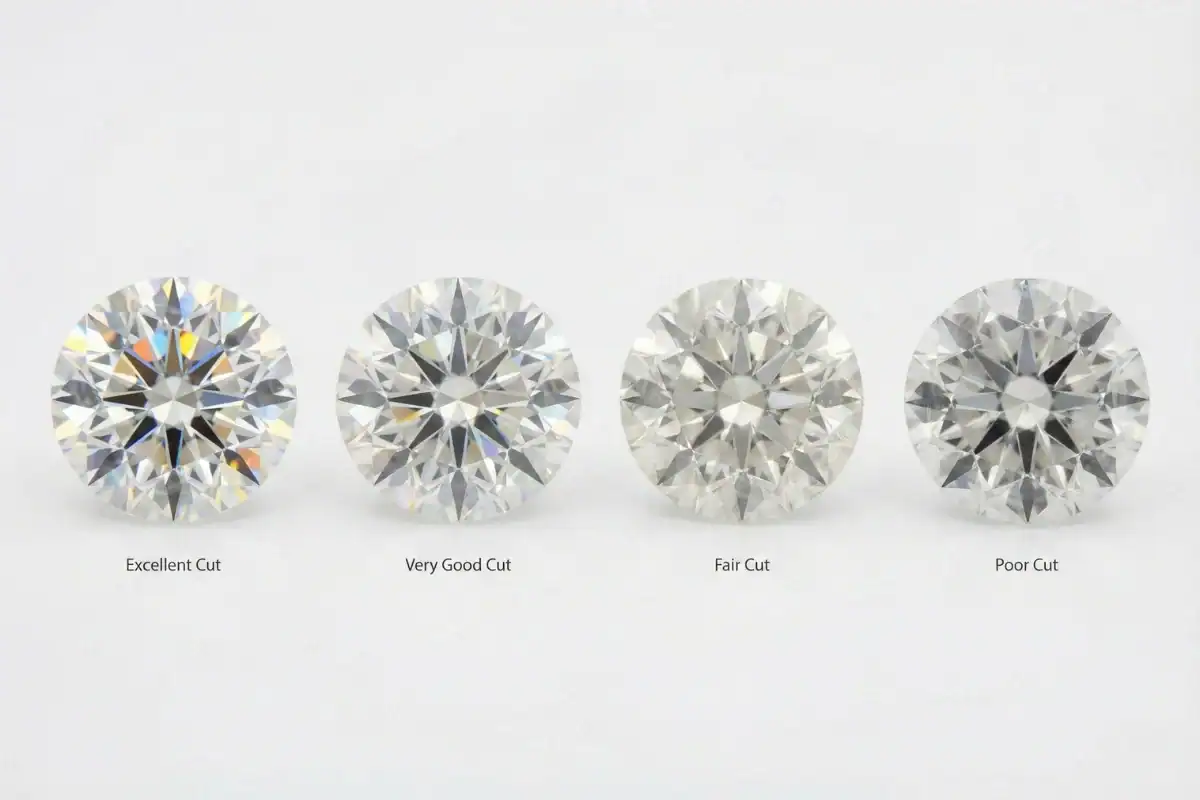
Visual comparison of Excellent, Very Good, and Good diamond cuts — the single biggest factor in how your diamond looks.
Colour (D to Z Scale)
Colour grades how “white” or colourless a diamond appears. D is perfectly colourless. Z has visible yellow tint.
| Colour Grade | Appearance | Price vs D | Recommendation |
|---|---|---|---|
| D-E | Perfectly colourless | Baseline | Premium spec |
| F-G | Near colourless | 15–25% less | Best value (Highly Recommended) |
| H-I | Slight warmth | 30–40% less | Good for yellow gold settings |
| J-K | Noticeable warmth | 45–55% less | Budget option, visible tint |
For most buyers, E-G colour offers the sweet spot. The difference between E and G is invisible to untrained eyes, but the price difference is significant.
Clarity (FL to I3 Scale)
Clarity grades internal flaws (inclusions) and surface imperfections (blemishes).
| Clarity Grade | What It Means | Price vs IF | Recommendation |
|---|---|---|---|
| IF (Internally Flawless) | No flaws under 10x | Baseline | Premium, unnecessary for wear |
| VVS1-VVS2 | Tiny inclusions at 10x | 10–20% less | Excellent high tier |
| VS1-VS2 | Minor inclusions at 10x | 25–35% less | Best value (Highly Recommended) |
| SI1-SI2 | Noticeable flaws at 10x | 40–50% less | Check stone individually |
Key Finding: VS1-VS2 clarity is “eye-clean” in over 99% of lab-grown diamonds. No visible inclusions without magnification. Paying extra for VVS or IF clarity is paying for something only a gemologist with a loupe can detect.
How the 4Cs Combine: Real Example Pricing
For a 1-carat round lab-grown diamond, three quality tiers:
| Quality Level | Specs | Price Range |
|---|---|---|
| Budget | 1ct, H colour, VS2, Very Good cut | ₹28,000 – ₹35,000 |
| Best Value | 1ct, F-G colour, VS1-VVS2, Excellent cut | ₹42,000 – ₹52,000 |
| Premium | 1ct, D-E colour, VVS1-IF, Excellent cut | ₹58,000 – ₹78,000 |
At Chaitra, we recommend “Best Value” specs for most buyers. You get a stunning diamond that performs beautifully without paying for differences you can’t see.
Not sure which specs to choose?
Tell us your occasion, budget, and style preferences. We'll send 3 curated options with exact prices directly to your WhatsApp within 24 hours. Completely free.
Get My 3 Curated OptionsAverage selection response time: under 4 hours
Lab Grown Diamond Price by Shape
Round brilliant is the most expensive shape. The cutting process wastes more rough diamond — about 60% of the rough is lost on a round versus 45–50% for ovals. Less waste means lower cost, plus round commands a premium as the most popular shape worldwide.
Fancy shapes (everything except round) cost 10–25% less for the same carat weight and quality.
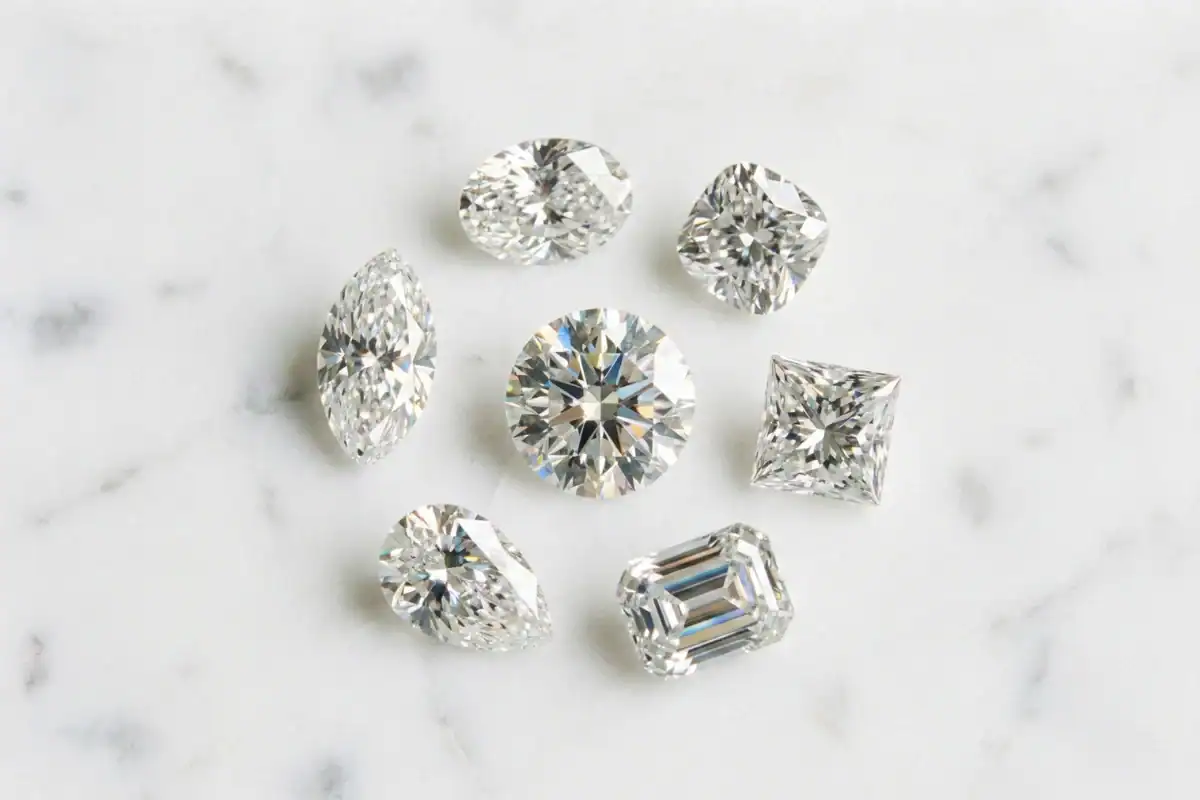
All popular lab grown diamond shapes at 1 carat — round costs the most, fancy shapes give you visible size savings.
Price Comparison by Shape (1 Carat, E/VVS, Excellent Cut)
| Shape | Price Range | vs Round | Face-Up Size (Visual Impact) |
|---|---|---|---|
| Round Brilliant | ₹40,000 – ₹55,000 | Baseline | 6.5mm diameter |
| Oval | ₹35,000 – ₹48,000 | 12–15% less | 7.5mm × 5.5mm (Looks Larger) |
| Cushion | ₹33,000 – ₹46,000 | 15–20% less | 6.5mm × 6.5mm |
| Princess | ₹33,000 – ₹46,000 | 15–20% less | 5.5mm × 5.5mm |
| Emerald | ₹30,000 – ₹42,000 | 18–25% less | 7mm × 5mm |
| Pear | ₹33,000 – ₹47,000 | 15–18% less | 8mm × 5.5mm (Looks Larger) |
| Marquise | ₹30,000 – ₹42,000 | 18–25% less | 10mm × 5mm (Looks Much Larger) |
Key Finding: Ovals offer the best value-to-visual-size ratio. They cost 12–15% less than rounds for identical specs while appearing 10–15% larger on the finger. A 1-carat oval looks closer to a 1.2-carat round in face-up size.
Lab Grown vs Natural Diamond Price Comparison
Lab-grown and natural diamonds are chemically identical. Same carbon crystal structure. Same 10 on the Mohs hardness scale. Same brilliance, fire, and scintillation. The only difference is origin — one grew in the earth over millions of years, one grew in a lab over weeks.
The price difference is dramatic.
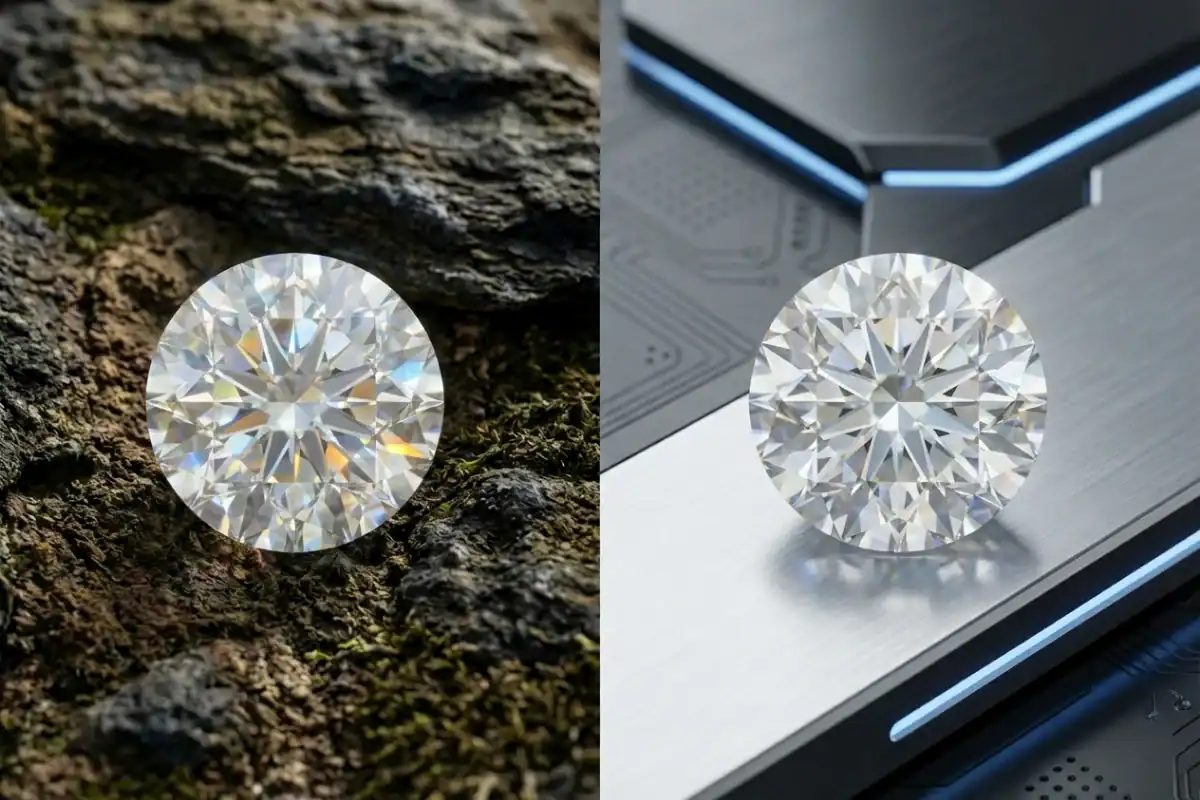
Lab grown vs natural diamond — identical sparkle, hardness, and IGI certification. The only real difference is price.
Price Comparison: Lab Grown vs Natural (E/VVS, Excellent Cut)
| Carat | Lab Grown Price | Natural Price | Your Savings |
|---|---|---|---|
| 0.5 ct | ₹15,500 | ₹55,000 | ₹39,500 (72%) |
| 1.0 ct | ₹47,000 | ₹1,80,000 | ₹1,33,000 (74%) |
| 1.5 ct | ₹68,000 | ₹3,20,000 | ₹2,52,000 (79%) |
| 2.0 ct | ₹1,00,000 | ₹5,50,000 | ₹4,50,000 (82%) |
| 3.0 ct | ₹1,75,000 | ₹19,00,000+ | ₹17,25,000+ (91%) |
What ₹1,50,000 Actually Gets You
| Option | What You Secure | Visual Finger Impact |
|---|---|---|
| Natural Diamond | 0.7ct, H colour, VS2, 14K gold setting | Small, subtle warm hue |
| Lab Grown Diamond | 1.8ct, E colour, VVS1, 18K gold setting | Large, perfectly white, high brilliance |
Same budget. Dramatically different ring. This is why 63% of engagement ring buyers under 35 in India now choose lab-grown.
Lab Grown Diamond Jewellery Prices in India
Loose diamond prices are one thing. What about finished jewellery?
Final price = Diamond cost + Gold cost + Making charges + GST (3%). Below are realistic ranges for August 2026.
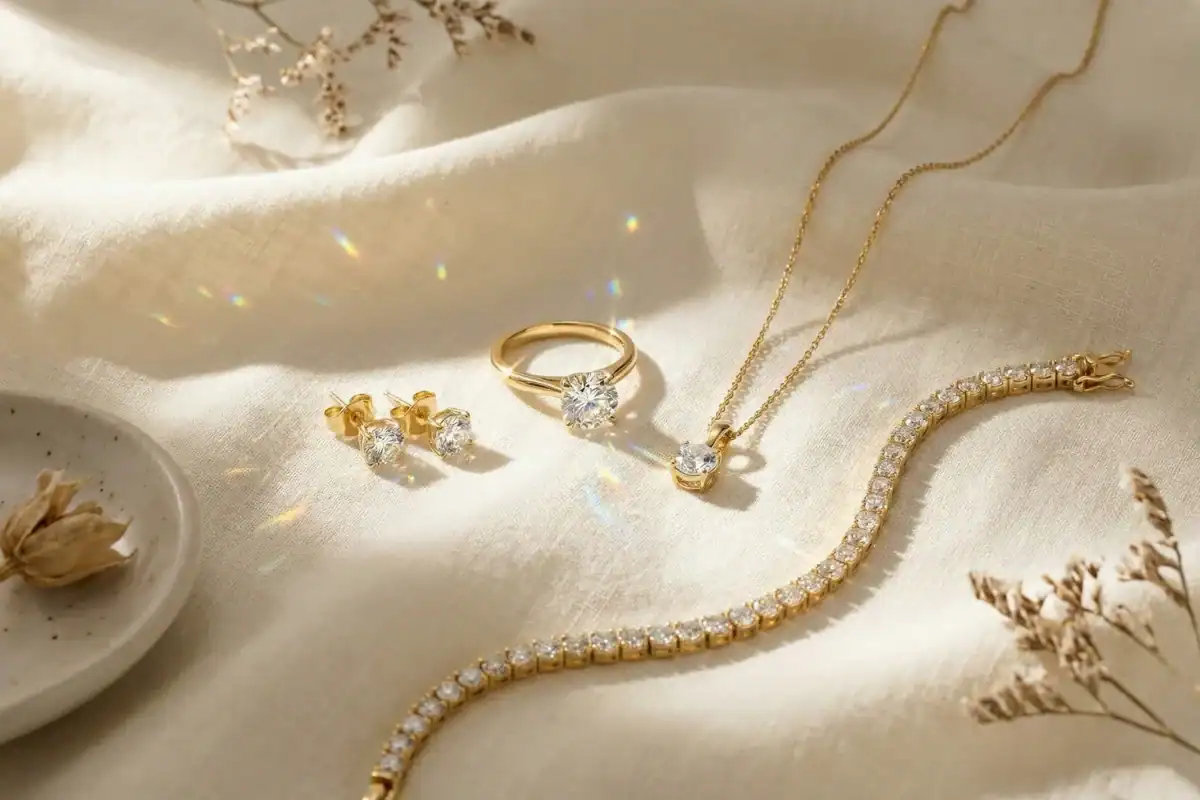
Lab grown diamond jewellery starts at ₹25,000 for everyday pieces and ranges to ₹10 lakh+ for statement tennis bracelets and heirloom solitaires.
Lab Grown Diamond Ring Prices
| Ring Type | Diamond Specs | 14K Gold Total | 18K Gold Total |
|---|---|---|---|
| Solitaire Ring | 0.5ct E/VVS | ₹35,000 – ₹45,000 | ₹42,000 – ₹55,000 |
| Solitaire Ring | 1ct E/VVS | ₹55,000 – ₹80,000 | ₹65,000 – ₹95,000 |
| Solitaire Ring | 1.5ct E/VVS | ₹85,000 – ₹1,15,000 | ₹98,000 – ₹1,35,000 |
| Solitaire Ring | 2ct E/VVS | ₹1,15,000 – ₹1,55,000 | ₹1,30,000 – ₹1,85,000 |
| Toi et Moi Ring | 1ct total (2 stones) | ₹68,000 – ₹88,000 | ₹80,000 – ₹1,05,000 |
| Three-Stone Ring | 1.5ct total | ₹78,000 – ₹1,05,000 | ₹95,000 – ₹1,25,000 |
Lab Grown Diamond Earring Prices
| Earring Type | Diamond Specs | 14K Gold Pair | 18K Gold Pair |
|---|---|---|---|
| Stud Earrings | 0.5ct pair (0.25ct each) | ₹22,000 – ₹32,000 | ₹28,000 – ₹40,000 |
| Stud Earrings | 1ct pair (0.5ct each) | ₹40,000 – ₹55,000 | ₹50,000 – ₹68,000 |
| Stud Earrings | 2ct pair (1ct each) | ₹88,000 – ₹1,18,000 | ₹1,05,000 – ₹1,40,000 |
| Drop Earrings | 1ct total | ₹52,000 – ₹72,000 | ₹65,000 – ₹88,000 |
Lab Grown Diamond Pendant Prices
| Pendant Type | Diamond Specs | 14K Gold | 18K Gold |
|---|---|---|---|
| Solitaire Pendant | 0.5ct E/VVS | ₹28,000 – ₹40,000 | ₹36,000 – ₹50,000 |
| Solitaire Pendant | 1ct E/VVS | ₹52,000 – ₹72,000 | ₹65,000 – ₹85,000 |
| Halo Pendant | 0.7ct centre + 0.3ct halo | ₹48,000 – ₹62,000 | ₹58,000 – ₹78,000 |
Lab Grown Tennis Bracelet Prices
| Total Carat Weight | 14K Gold Line | 18K Gold Line |
|---|---|---|
| 3ct total weight | ₹1,25,000 – ₹1,55,000 | ₹1,50,000 – ₹1,85,000 |
| 5ct total weight | ₹1,95,000 – ₹2,50,000 | ₹2,30,000 – ₹2,95,000 |
| 7ct total weight | ₹2,65,000 – ₹3,35,000 | ₹3,15,000 – ₹4,05,000 |
All retail prices include structural IGI certified diamonds, BIS hallmarked gold framework, luxury distribution making costs, and standard 3% GST layout with free India tracking shipping.
How a Real Buyer Decides: Esha’s Story
Esha, a tech startup CEO in Bangalore, came to us in April 2026 after working through what felt like every lab-grown diamond website in the country. She knew exactly what she wanted: a tennis bracelet she could wear to office every day. White gold. Clean, modern lines. Nothing heavy.
What she couldn’t find anywhere else: pricing clarity, proof of quality, transparent delivery timelines, a real buyback policy. The designs she did find were too heavy, too traditional — not the clean global aesthetic she wanted for daily wear at work.
She picked our 5-carat emerald and round mixed-cut diamond tennis bracelet in 14K white gold for ₹2,50,000. Mixed cuts make it more interesting than a uniform line of rounds, and white gold reads modern rather than traditional.
“You actually told me everything upfront. No other site did that.”
Where to Buy Lab Grown Diamonds in India
Three main channels exist for buying lab-grown diamonds in India, each with its trade-offs.
Comparison: Where to Buy Channels
| Factor | Online Specialists (e.g., Chaitra) | Traditional Retailers | Surat Direct B2B |
|---|---|---|---|
| Price | Optimal Baseline Cost | 15–25% Markup Overhead | 15–30% Lower Sheet |
| Certification | Independent IGI on all | IGI on select inventory | Highly Uncertified |
| Buyback | Guaranteed Lifetime Terms | Highly Restricted / In-Store Credit | Zero Resale Support |
| Returns | 30-Day Window Guarantee | 7–14 Day Variations | Final Absolute Sale |
| Design Range | 500+ Digital Curations | Constrained In-Store Stock | Loose Unmounted Only |
| Purity Hallmark | Yes, Native BIS Stamps | Yes | Manual Counter-Verify Required |
Online Specialists (best value for most buyers)
Brands like Chaitra Fine Jewels that focus exclusively on lab-grown diamonds typically offer the best prices. Lower overhead, deeper specialisation, transparent pricing. You’re buying from specialists who understand the category and stock breadth across designs.
At Chaitra, every piece ships with:
- IGI certification on every diamond
- BIS hallmarking on all gold
- Complete price breakdown — diamond + gold + making + GST
- 30-day free returns
- Lifetime exchange
- Lifetime buyback (see math below)
- Free resizing & Free shipping across India
Traditional Jewellers
Tanishq, Kalyan, Malabar Gold now carry lab-grown options. Lab-grown selection is narrower than at specialists. Prices tend to be 15–25% higher due to retail overhead. But if you want the in-store experience and to see pieces in person before buying, this is the path.
Surat Direct (high risk)
Some buyers try to buy loose stones directly from Surat manufacturers expecting 15–30% savings. In practice, you give up certification guarantees, return policies, and after-sales support. Uncertified stones lose 40–60% of resale value when you eventually need to sell. Not recommended for non-trade buyers.
Key Finding: Chaitra Fine Jewels is one of the only Indian brands offering lifetime buyback specifically on lab-grown diamond jewellery, with buyback value calculated against the current market rate of the diamond and metal at the time of return.
What to Verify Before Buying (Any Channel)
- IGI or GIA certification: Every diamond above 0.3ct should have independent certification
- BIS hallmark on gold: Look for the BIS stamp showing purity grade and jeweller ID
- Return policy: Minimum 14 days, ideally 30
- Price breakdown: Diamond, gold, making charges should be shown separately
- Buyback terms: Get specifics in writing before you buy
Lifetime Buyback: What Your Lab Grown Diamond Actually Recovers
One of the most-asked questions about lab-grown diamonds: do they hold value? Common online answers range from “no resale value at all” to “20–40% recovery.” Both are usually wrong. The right answer depends on the brand’s buyback policy and how lab-grown prices move over time.
Here’s how Chaitra’s Lifetime Buyback policy actually works in numbers.
The Real Math Case Evaluation
You pay ₹50,000 for a 1-carat lab-grown solitaire today. Five years from now, you decide to sell it back. The buyback calculation:
- Diamond baseline value: Current market rate of an identical 1-carat stone on return date. Assuming an 8% scale contraction, say ₹35,000 baseline in 2031.
- Handling operational deduction: 15% standard index clawback. ₹35,000 minus 15% = ₹29,750 net value.
- Gold scrap evaluation value: Current live bullion market spot rate. If your item integrated 4g of 14K metal, moving from ₹6,000 baseline to a progressive ₹8,000 spot margin, that nets ₹32,000.
- Logistics handling: Flat transit correction of ₹1,000.
- Documentation criteria: No deductions tracking if your native independent diamond profile certificate returns intact.
Total realized liquidity recovery: ₹29,750 (Stone Value) + ₹32,000 (Metal Appreciated Spot) − ₹1,000 (Transit) = ₹60,750 Final Payout.
You paid ₹50,000 for the stone plus roughly ₹25,000 for setting (gold, making, GST) — say ₹75,000 total. Buyback recovers ₹60,750, which is around 81% of the total purchase price.
Key Finding: Under Chaitra’s lifetime buyback policy, a typical 1-carat lab-grown diamond ring purchase recovers 70–85% of the original total price over 5–7 years, with gold appreciation offsetting most of the diamond’s market decline. This significantly exceeds the 20–40% resale value most jewellery retailers quote for lab-grown stones.
Price Trends: Are Lab Grown Diamonds Still Getting Cheaper?
Yes, but the rate of decline has slowed sharply. Prices fell 20%+ annually between 2022 and 2024. In 2025, the decline narrowed to 8%. In 2026, we’re looking at 5–6% as production cost floors are approached.
Historical Price Trend (1ct E/VVS Round Cut)
| Year Tracking Context | Approximate Market Price Range | Annualized Index Variance |
|---|---|---|
| 2022 Baseline | ₹65,000 – ₹80,000 | Baseline Index Floor |
| 2023 Consolidated | ₹52,000 – ₹68,000 | −18% Deflation Shift |
| 2024 Consolidated | ₹42,000 – ₹58,000 | −16% Technology Scale |
| 2025 Matrix | ₹38,000 – ₹52,000 | −8% Deflation Softening |
| 2026 (May Standard Live) | ₹40,000 – ₹55,000 | Stabilised Curve Support |
How to Get the Best Value
Smart buying can save you 20–30% without sacrificing visible quality. Six tactics:
- 1. Buy Just Below Magic Numbers: Diamond prices jump at round numbers: 0.5ct, 1ct, 1.5ct, 2ct. A 0.95ct diamond costs 10–15% less than a 1.0ct with no visible size difference.
- 2. Choose F-G Colour Over D-E: The colour difference between D and G is invisible to 95% of people without side-by-side comparison under specialist lighting. The price difference is 20–25%.
- 3. Go VS1-VS2 Clarity: You’re paying for invisible differences with VVS or IF clarity. VS is “eye-clean” and looks identical when worn.
- 4. Never Compromise on Cut: This is the one place to insist on Excellent. Cut is the only factor you can see with your naked eye.
- 5. Consider Fancy Shapes: Ovals, cushions, emeralds, and pears cost 15–25% less than rounds for the same specs.
- 6. Compare Total Landed Price, Not Just Diamond Price: Always ask for the complete breakdown: diamond + gold + making + GST.
Know what you want? Let us match your criteria.
Share your target specifications and budget limit. We'll verify raw inventory and send 3 hand-picked options with exact pricing to your WhatsApp within 24 hours.
Get My 3 Curated OptionsAverage selection response time: under 4 hours
About This Data Validation Framework
Prices reflect live catalog alignment. Diamond configurations retain independent authentication via the International Gemological Institute (IGI). Structural market monitoring parameters track aggregate reporting derived via Bain & Company Global Diamond Framework models, alongside certified live regional updates issued directly via GJEPC index structures.
Frequently Asked Questions
What is the price of a 1 carat lab grown diamond in India?+
How much does a 0.5 carat lab grown diamond cost in India?+
What is the price of a 2 carat lab grown diamond ring in India?+
How much does a 5 carat lab grown diamond cost in India?+
Are lab grown diamonds cheaper than natural diamonds?+
Why are lab grown diamond prices different from store to store?+
Are lab grown diamond prices falling?+
Should I wait for lab grown diamond prices to drop further?+
Is a lab grown diamond a good investment?+
What is the lab grown diamond rate per carat in India?+
Why do oval diamonds cost less than round?+
Do lab grown diamond prices change with gold rates?+
Are Surat lab grown diamonds cheaper?+
What is the cheapest lab grown diamond I can buy in India?+
How much does a lab grown diamond engagement ring cost in India?+
What certification should I look for?+
Ready to Buy?
Lab grown diamonds in India in 2026 sit at a rare intersection: real diamonds, fully certified, at a price most buyers can actually afford for the size they actually want. Whether you’re shopping for an engagement ring, an anniversary gift, or a self-purchase that’s been a long time coming, the pricing context above tells you what fair looks like.
At Chaitra, every diamond is IGI certified, every setting is BIS hallmarked, and every price is shown with full breakdown. Combined with 30-day returns, lifetime exchange, and lifetime buyback, your purchase is protected end-to-end. Use our AI Lookbook to see how any piece looks on you before you buy.
Prefer a private 15-min call? Book a free consultation
About the Author: This guide is written and maintained by the Chaitra Fine Jewels team in Bengaluru. We specialise in IGI-certified lab-grown diamond jewellery since 2022. For questions about pricing or custom designs, book a consultation or reach us on WhatsApp.